
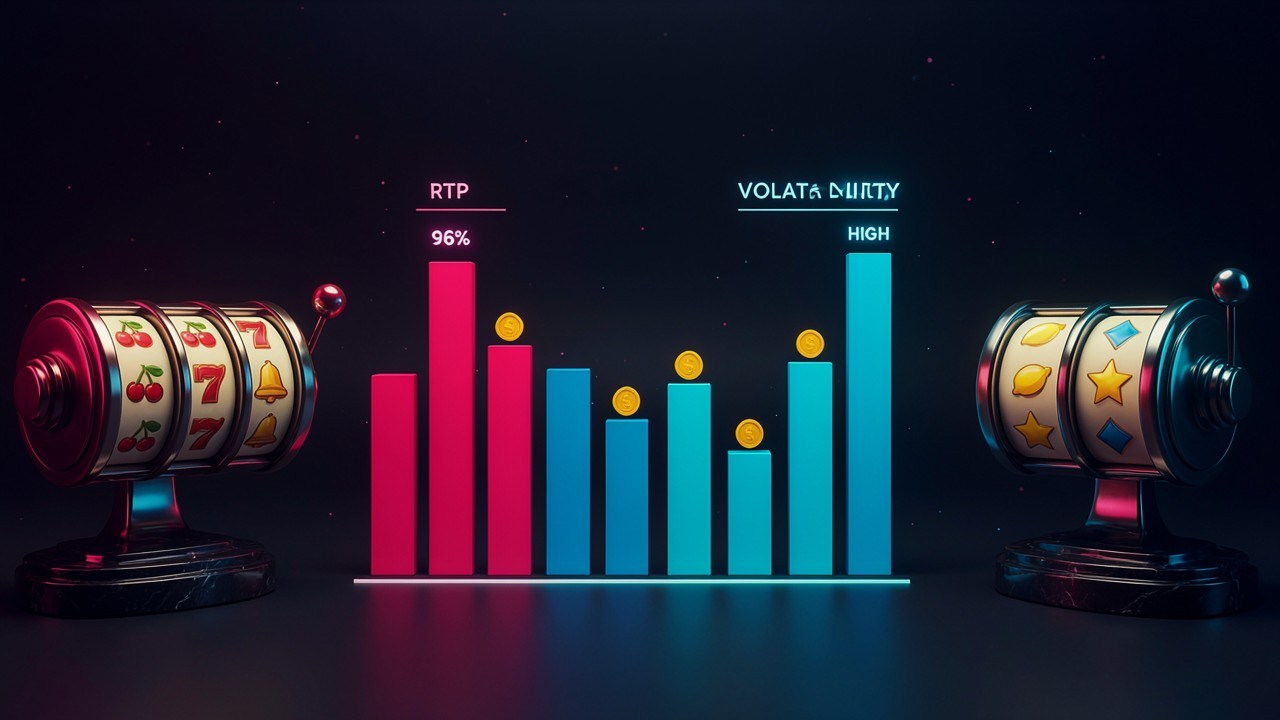
Online slot choose karte waqt do terms baar-baar saamne aati hain:
RTP aur volatility. Problem ye hai ki beginners
often dono ko same cheez samajh lete hain. 96% RTP dekha toh assume kar liya
ki slot frequently pay karega. “High volatility” padha toh laga RTP low hoga.
Actually slot RTP aur volatility do different concepts hain —
ek long-run theoretical return ke baare mein batata hai, doosra broadly ye
describe karta hai ki payouts ka distribution kitna uneven ya swingy ho sakta hai.
Short version: RTP asks, “Long run mein theoretical return kitna hai?”
Volatility asks, “Woh return kis type ke ups and downs ke through aa sakta hai?”
Neither number aapke next spin ya ek short slot session ka result guarantee karta hai.
Pehle RTP Ko Simple Language Mein Samjho
RTP ka full form hai:
Suppose ek slot ka theoretical RTP:
Iska matlab ye nahi:
“Main ₹100 dalunga aur machine mujhe ₹96 de degi.”
96% RTP ek long-run theoretical characteristic hai. Individual session mein actual
result theoretical percentage se bahut different ho sakta hai.
Volatility Kya Hoti Hai?
Slot volatility, jise variance bhi kaha ja sakta hai, broadly payout
pattern ke swings ko describe karti hai.
Simplified way mein:
Lower Volatility
Generally more frequent smaller outcomes aur relatively smoother balance
movement se associated ho sakti hai.
Medium Volatility
Frequency aur payout size ke beech comparatively mixed profile ho sakti hai.
Higher Volatility
Longer dry stretches aur less frequent but potentially larger outcomes
ke saath associated ho sakti hai.
Ye general description hai. Exact payout distribution har slot ke mathematics aur
paytable par depend karti hai.
RTP Aur Volatility Ka Biggest Difference
| Factor | RTP | Volatility |
|---|---|---|
| Main Question | Long-run theoretical return kitna? | Payouts kis type ke swings mein distributed ho sakte hain? |
| Usually Expressed As | Percentage, e.g. 96% | Low, medium, high or similar rating |
| Next Spin Predict Karta Hai? | No | No |
| Session Experience Par Effect | Long-run maths ka part | Short-term swings ko strongly influence kar sakti hai |
| Guaranteed Return? | No | No |
Same RTP, Completely Different Slot Experience Possible Hai
Imagine do hypothetical online slots hain.
| Slot A | Slot B | |
|---|---|---|
| RTP | 96% | 96% |
| Volatility | Lower | Higher |
| General Feel | More frequent smaller returns | Potentially longer dry stretches |
| Larger Outcomes | May be less central to distribution | May contribute more heavily to distribution |
Both slots ka theoretical RTP same ho sakta hai.
Playing experience phir bhi dramatically different feel ho sakta hai.
Ek Simple Example
Purely illustration ke liye imagine karo ki do games ne ek sample period mein same
total return produce kiya.
Slot A ke hypothetical returns:
Slot B ke hypothetical returns:
Ye actual slot model nahi, sirf concept explain karne ka simplified example hai.
Total return similar ho sakta hai.
Experience?
Isliye 96% RTP Dekhkar “Frequent Wins” Assume Nahi Kar Sakte
Suppose game information says:
Is number se alone aapko ye nahi pata:
- next 10 spins mein kitne payouts aayenge,
- bonus kab trigger hoga,
- small wins kitni frequent hongi,
- jackpot kab hit hoga,
- ₹500 kitni der chalega,
- ya session profit mein finish hoga ya loss mein.
High RTP + High Volatility Possible Hai?
Yes.
High RTP aur high volatility mutually exclusive nahi hain.
Hypothetical example:
RTP: 97%
Volatility: High
Game ka long-run theoretical return relatively high ho sakta hai while short sessions
still large swings experience kar sakte hain.
Low RTP + Low Volatility Bhi Possible Hai?
Yes.
Example:
RTP: 94%
Volatility: Low
Game frequent small returns de sakta hai but long-run theoretical return lower ho sakta hai.
Frequent payout ka matlab mathematically better RTP nahi.
Frequent Wins Ka Matlab High RTP?
Not necessarily.
Suppose ₹50 bet par ye returns aaye:
| Spin | Bet | Return | Net |
|---|---|---|---|
| 1 | ₹50 | ₹20 | -₹30 |
| 2 | ₹50 | ₹35 | -₹15 |
| 3 | ₹50 | ₹10 | -₹40 |
| 4 | ₹50 | ₹40 | -₹10 |
Four spins mein four payouts show ho sakte hain.
Total wagered:
Total returned:
Net:
Frequent payout animations automatically profitable session nahi banati.
Hit Frequency, RTP Aur Volatility—Teen Alag Terms
Confusion aur badh jaati hai jab hit frequency bhi discussion mein aa jaye.
| Term | Simplified Meaning |
|---|---|
| RTP | Long-run theoretical return percentage |
| Volatility | Payout distribution ke swings / variability |
| Hit Frequency | How often a defined paying outcome may occur under the game’s mathematics |
In teen numbers ko interchangeable nahi samajhna chahiye.
High Hit Frequency = Profit Zyada?
Again, no.
A slot may produce frequent returns that are smaller than the original stake.
Example:
₹20 bet → ₹8 return = payout occurred, but net result is -₹12.
So hit frequency alone overall profitability explain nahi karti.
RTP Ko Average Samajhna Useful Hai—Lekin Carefully
Suppose theoretical RTP 96% hai.
Very large amount of qualifying wagering ke context mein mathematical expectation
roughly 96% return structure ko represent karti hai, subject to game design and
theoretical model.
But individual player session:
96%, 90%, 50%, 150%, 300% or even 0% of that session’s wagering ke around result
experience kar sakta hai.
Short-run outcome theoretical RTP se tightly locked nahi hota.
Volatility Isi Short-Term Experience Mein Zyada Notice Hoti Hai
Higher-volatility game mein player ko aisa sequence mil sakta hai:
Then suddenly:
Lower-volatility game may feel more like:
Again, these are conceptual illustrations, not promised patterns.
₹500 Bankroll Par Difference Kaise Feel Ho Sakta Hai?
Suppose same ₹500 starting balance aur ₹10 fixed bet hai.
Lower-Volatility Experience
Small returns balance ko repeatedly recycle kar sakte hain.
Session potentially more gradual feel ho sakta hai, but no duration guarantee.
Higher-Volatility Experience
Long dry stretch balance ko quickly reduce kar sakta hai.
A larger payout may occur, but it is not guaranteed to arrive before bankroll runs out.
“High Volatility Hai, Toh Big Win Due Hai”
Ye common misunderstanding hai.
High volatility ka matlab:
“Agar main enough losses dekh loon, eventually mujhe guaranteed big win milegi”
nahi hota.
Distribution mein larger outcomes ka role greater ho sakta hai, but a specific player
ke limited session mein big win arrive karna guaranteed nahi.
“Low Volatility Hai, Toh Paisa Lose Nahi Hoga”
Ye bhi wrong assumption hai.
Lower volatility risk-free nahi hoti.
Frequent smaller payouts balance decline ko smoother feel kara sakte hain, but repeated
wagering ke through money still decrease ho sakta hai.
Same RTP Ka Mathematical Distribution Different Kaise Ho Sakta Hai?
Simplified hypothetical example:
Imagine 100 units wagered across a very simplified theoretical model.
Game A could distribute its theoretical returns across many smaller outcomes.
Game B could concentrate more return into fewer larger outcomes.
Both could theoretically target a similar overall RTP while variance differs.
Same destination percentage does not require the same journey.
Ek Road Trip Analogy
RTP aur volatility ko road trip ki tarah imagine karo.
Two roads same destination tak ja sakti hain.
Road A
Relatively smoother road with smaller ups and downs.
Road B
Big climbs, steep drops and more dramatic movement.
Destination analogy RTP ko represent kar sakti hai.
Road ke bumps volatility ko.
Of course actual slot mathematics is more complex, but distinction samajhne ke liye
analogy useful hai.
RTP Higher Ho Toh Kya Woh Better Hai?
Pure mathematical long-run perspective se, all else equal, higher RTP means lower
theoretical house edge.
Example:
| RTP | Theoretical House Edge |
|---|---|
| 94% | 6% |
| 95% | 5% |
| 96% | 4% |
| 97% | 3% |
Formula:
But individual session result still unpredictable hai.
97% RTP Slot 94% RTP Slot Se Short Session Mein Lose Kar Sakta Hai?
Absolutely possible.
Example:
| Game | RTP | One Hypothetical Short Session |
|---|---|---|
| Slot A | 97% | -₹500 |
| Slot B | 94% | +₹250 |
Is example se RTP wrong prove nahi hua.
Short session long-run expectation ko reproduce karna required nahi.
Volatility Ko “Risk Level” Kehna Sahi Hai?
Informal explanation mein log volatility ko low-risk/high-risk bol dete hain,
but wording carefully use karni chahiye.
High volatility generally larger balance swings imply kar sakti hai.
But:
Low-volatility gambling financially safe nahi ho jati.
Real-money wagering mein loss risk remains.
Volatility Aur Bankroll Ka Connection
Suppose:
Starting balance = ₹500
Bet = ₹50 per spin
Zero-return sequence mein bankroll:
| After Spin | Balance If Return Is ₹0 Each Time |
|---|---|
| 1 | ₹450 |
| 2 | ₹400 |
| 3 | ₹350 |
| 4 | ₹300 |
| 5 | ₹250 |
| 6 | ₹200 |
| 7 | ₹150 |
| 8 | ₹100 |
| 9 | ₹50 |
| 10 | ₹0 |
High-volatility game mein meaningful return se pehle dry sequence possible ho sakti hai.
Isliye large bet + limited balance combination session ko quickly end kar sakta hai.
Bet Size Volatility Ko Change Karti Hai?
Simply ₹10 se ₹100 bet karna underlying game volatility ko automatically change nahi
karta unless game rules/configuration specifically change.
But rupee terms mein swings obviously larger ho jate hain.
| Multiplier Result | ₹10 Bet | ₹100 Bet |
|---|---|---|
| 0× | ₹0 return | ₹0 return |
| 2× | ₹20 | ₹200 |
| 10× | ₹100 | ₹1,000 |
| 50× | ₹500 | ₹5,000 |
Mathematical profile may remain the same while real-money swings become 10× larger.
Bonus Features Volatility Ko Affect Kar Sakte Hain?
Yes, depending on game design.
Some slots apne theoretical return ka meaningful portion features such as:
- free spins,
- multipliers,
- bonus rounds,
- Wild features,
- jackpots,
- or rare high-value combinations
ke through distribute kar sakte hain.
Agar larger share rare outcomes mein concentrated ho, game experience more volatile feel
ho sakta hai.
Maximum Win Dekhkar Volatility Guess Kar Sakte Hain?
Maximum win useful information hai, but alone complete volatility measure nahi.
Example:
Ye large possible outcome batata hai.
But exact probability distribution, hit frequency aur other payouts ka structure
jaane bina volatility ka complete picture nahi milta.
“High Volatility = Better Jackpot Chance”?
Not necessarily.
Volatility rating alone jackpot probability nahi batati.
Jackpot mechanics separate ho sakti hain:
- fixed jackpot,
- progressive jackpot,
- random jackpot,
- symbol-triggered jackpot,
- or other game-specific structures.
Exact rules paytable se check karne chahiye.
Same Slot Ka RTP Different Websites Par Different Ho Sakta Hai?
Some slot titles multiple approved RTP configurations mein available ho sakte hain.
Example, hypothetically:
| Configuration | Example RTP |
|---|---|
| A | 96% |
| B | 94% |
| C | 92% |
These percentages are illustrative.
Point ye hai ki sirf slot title dekhkar exact RTP assume karna always safe nahi.
Actual game information check karni chahiye.
Volatility Rating Standardized Hoti Hai?
RTP ki tarah volatility ko always ek universally identical public scale par present
nahi kiya jata.
Providers may describe games as:
Low-Medium
Medium
Medium-High
High
Exact methodology provider ke according differ kar sakti hai.
RTP vs Volatility: Four Hypothetical Slots
| Slot | RTP | Volatility | Possible General Experience |
|---|---|---|---|
| A | 96% | Low | More frequent smaller outcomes may create smoother play |
| B | 96% | High | Same theoretical RTP but potentially larger swings |
| C | 94% | Low | Smoother feel does not remove lower theoretical return |
| D | 97% | High | Higher theoretical RTP can still come with large short-run swings |
Ye examples concept explain karte hain; actual games ki specifications separately verify karni chahiye.
RTP Aur Volatility Se Next Spin Predict Kar Sakte Hain?
Nahi.
Suppose:
RTP = 96%
Volatility = High
Next spin:
- loss ho sakta hai,
- small return ho sakta hai,
- break-even type return ho sakta hai,
- larger outcome ho sakta hai,
- or another result allowed by the game.
RTP + volatility future spin ka exact answer nahi dete.
20 Losing Spins Ke Baad High Volatility Slot Mein Big Win Due?
Nahi.
Ye gambler’s fallacy ban sakti hai:
“Game high volatility hai. Itne losses ho gaye, ab bada hit aana hi hai.”
High volatility long dry stretches ko possible bana sakti hai.
But dry stretch ko guaranteed upcoming big payout mein convert nahi karti.
20 Small Wins Ke Baad Low Volatility Slot Safe Hai?
Also no.
Small returns repeatedly aane ke bawajood:
Total returned amount total wagered amount se lower ho sakta hai.
Payout activity aur net financial result ko separate dekho.
RTP Aur Volatility Ko Car Analogy Se Samjho
Ek rough analogy:
RTP ko long-run fuel efficiency figure jaisa imagine karo.
Volatility ko road kitni smooth ya bumpy hai uske jaisa imagine karo.
Fuel figure road ke every second ka experience nahi batata.
Aur smooth road automatically better fuel economy guarantee nahi karti.
Analogy imperfect hai, but concepts separate rakhne mein help karti hai.
RTP vs Volatility Ke Common Myths
Reality: RTP long-run theoretical return hai; payout frequency separate concept hai.
Reality: A game can have high RTP and high volatility simultaneously.
Reality: Random sequences and bet size can still produce significant losses.
Reality: A specific player is not guaranteed to encounter a large outcome.
Reality: RTP is not a personal-session refund calculation.
Reality: Payout size, hit frequency, volatility and RTP are distinct metrics.
Slot Information Screen Mein Kya Check Karna Chahiye?
- Exact RTP percentage available hai?
- Volatility rating mentioned hai?
- Paytable kya hai?
- Wild aur Scatter kaise work karte hain?
- Bonus feature ka trigger kya hai?
- Jackpot rules kya hain?
- Maximum win kya hai?
- Different bet settings se mechanics change hoti hain ya nahi?
Sirf RTP Dekhna Enough Nahi
Do games ka RTP:
96%
same ho sakta hai.
But one game aapko relatively frequent small returns dikha sakta hai while another
game long dry stretches aur occasional larger outcomes ke around designed ho sakta hai.
Isliye RTP ko isolated number ki tarah nahi samajhna chahiye.
Sirf Volatility Dekhna Bhi Enough Nahi
“Low volatility” label dekhkar game ko financially safe assume nahi karna chahiye.
Similarly:
“High volatility = high reward”
ko guaranteed personal outcome samajhna misleading hai.
Volatility distribution describe karti hai, promise nahi.
RTP, Volatility Aur Bet Size—Teeno Ko Saath Dekho
Suppose two players same high-volatility slot play kar rahe hain.
| Player A | Player B | |
|---|---|---|
| Starting Balance | ₹1,000 | ₹1,000 |
| Bet Per Spin | ₹10 | ₹100 |
| Zero-Return Spins Balance Can Cover | 100 | 10 |
Same game.
Same RTP.
Same volatility.
But bankroll exposure dramatically different.
RTP Aur Volatility Se Guaranteed Strategy Ban Sakti Hai?
Nahi.
They are useful game characteristics.
But neither tells you:
“Spin number 37 par bonus aayega.”
Ya:
“₹1,000 wager karne ke baad ₹960 definitely balance mein hoga.”
Ya:
“High volatility hai, 50 losses ke baad jackpot due hai.”
Final Baat: RTP Destination Ka Maths Hai, Volatility Journey Ke Swings
Slot RTP vs volatility ko ek hi cheez samajhna slot mathematics ki
sabse common misunderstandings mein se ek hai.
RTP:
Volatility:
Ek high-RTP slot high volatility ka ho sakta hai.
Ek lower-RTP slot low volatility ka ho sakta hai.
Do slots ka RTP same hote hue bhi playing experience completely different ho sakta hai.
“RTP batata hai long-run maths kya hai. Volatility batati hai ride kitni bumpy ho sakti hai.
Dono mein se koi bhi aapko next spin ka result nahi batata.”
Slot game online play karte waqt RTP, volatility, hit frequency, paytable aur bonus
mechanics ko separate concepts ke taur par samajhna useful hai. Lekin in numbers ko
guaranteed winning formula ya loss-recovery signal nahi samajhna chahiye.
Real-money slots ko entertainment ke perspective se rakhein. High RTP dekhkar spending
limit increase na karein aur high volatility ke naam par losses ke baad big win chase
na karein. Fixed spending aur time limits maintain karein, aur essential expenses ya
borrowed money ko gambling ke liye use na karein.